Wednesday, 7 December 2016

Comparison between QR code and Barcode


COMPARISON BETWEEN QR CODE & BARCODE


Attribute
Barcode
QR code
Data capacity
Can store up to 24 characters
Can store up to 2000 characters
Reading requirements
Require line of sight
Require line of site
Durability
Paper labels may subject to wear or damage
Efficiency
Only a single bar code can be scanned one at a time.
Are more limited than bar codes as scanning process will take longer, depending on the amount of data
Read-write
No read-write
Read-write is limited as new printing label is required
Security
Little to almost none security, which makes forgery easy
The data can be converted so, it is not really recommended for large scale tracking systems
Cost
basically free when printed during packaging
1 to 10 cents for paper label

Reading process
Is read automatically with the item being moved by a conveyor or past a scanning device


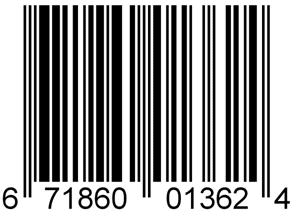
An example of barcode
            
(Source: barcodesinc)


An example of QR code


(Source: rawgithubusercontent.com)


PROS & CONS


Pros
Cons
Barcode
1) Simple solution
2) Can be automatically scanned
1) Numbers can overlap/clash
2) Hard to continue data with other system
3) Adding additional numbers later can cause problems if design is not well planned
4) Insecure: Numbers can be guessed
5) Requires proprietary scanning hardware and software
QR Code
1) Can be automatically scanned
2) Can sometime be scanned by smartphones and tablets with proprietary software
1) Numbers can overlap/ clash across teams/dept./existing software
2) Hard to combine data with other systems
3) Adding additional numbers later can cause problems if design is not well planned
4) Insecure: Numbers can be guessed
5) Requires proprietary software to view asset data


Thanks for your time. Do hit the comment section below! :)


Introduction to QR Codes and Bar Codes


QR CODE & BARCODE


In today's wonderful post, we are going to dig in the history of QR codes and bar codes that are being used nowadays in various products we used daily. 


QR codes were first created and developed in 1994 by a Toyota subsidiary named Denso Wave in order to help in the manufacturing process. Just like the name Quick Response code, it was designed for fast decoding speeds. 


Example of QR code : Whatsapp QR code


The incorporation of a QR barcodes reader in smart phones with cameras nowadays causes widespread use of QR Codes. The successful of QR code is due to the fast decoding speed in scanning, the accuracy of information, and their multiple functionalities. QR Codes can be found everywhere and anytime, and they can be scanned by consumers’ mobile phone. QR code is a combination of a GTIN and URL. It is  normally printed on paper or displayed on mobile phone screen of the customer.


Application of QR code


QR code helps to save the consumers’ time ad also allows the brand owners to implement promotion and marketing effectively. QR codes are used in traceability system for food and other product supply chains. The number of upstream suppliers using QR codes in processing food by encoding GS1 Data increased sharply. Government organizations recommending QR code to execute a traceability system in which QR codes act as an optional data carrier. Logistics companies begin to use QR Code to encode asset identifier.


QR code pattern


A barcode is an optical representation of data that can be read by machine where the data usually describes information  about the object with barcode. A barcode reader, also called as a price scanner or point-of-sale (POS) scanner, is a portable or stationary input device  used to decode information contained in a bar code .


Barcode scanner and barcode

A barcode reader consists of a scanner , a decoder, and a cable connected the reader with a computer. Barcode scanners can be connected to a computer through a serial port , keyboard port , or a link device called a wedge. A barcode reader captures and translates the barcode into numbers and letters, the data will then forwarded to a computer. It works by directing a beam of laser light or LED across the bar code. Light reflects back off barcode into a light-detecting electronic component called a photoelectric cell. The ability of dark bars on a barcode to reflect the light is less than the white spaces between them. As the scanner moves over the barcode, the cell generates a pattern of on-off pulses and an electric circuit converts these into binary digits. The binary digits will then translated into data by the decoder and sent to a computer.


                                                    Application of barcode reader


Thanks for your time, don't forget to the hit comment section. Thanks! ;)